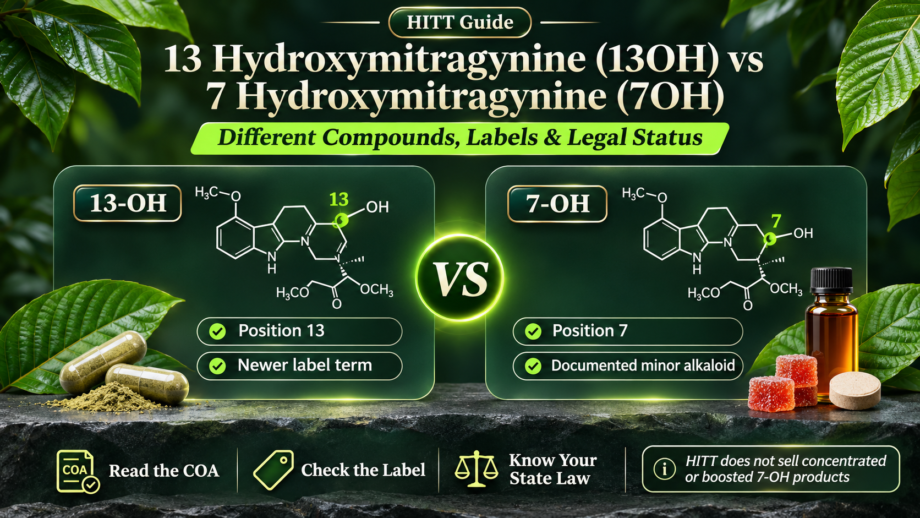
13-hydroxymitragynine (13-OH) and 7-hydroxymitragynine (7-OH) are two different kratom-related compounds, named for different positions on the mitragynine molecule. The “13” and the “7” are position numbers, so despite the matching names, 13-OH and 7-OH are not the same thing. 7-OH is a well-documented minor kratom alkaloid. 13-OH is a far newer label term with little published science.
This guide compares 13-OH and 7-OH by name, chemistry, how each is sold, and legal status. HITT focuses on mitragynine-based kratom and carries 13-OH products within its broader kratom range, and does not sell concentrated or boosted 7-OH products.
TL;DR: Key Takeaways
13-OH is short for 13-hydroxymitragynine and 7-OH is short for 7-hydroxymitragynine. The number is the position on the mitragynine molecule, so the two are different compounds. 7-OH is a documented minor kratom alkaloid and a mitragynine metabolite. 13-OH is a newer label term with little published research.
- 7-OH is 7-hydroxymitragynine, a position-7 compound. 13-OH is 13-hydroxymitragynine, a position-13 compound. Different positions mean different molecules.
- 7-hydroxymitragynine is a minor alkaloid found naturally in kratom leaf and a metabolite of mitragynine, documented in scientific and World Health Organization reviews.
- 13-hydroxymitragynine is a newer term that appears mainly on product labels, with little established scientific literature.
- In 2025 the FDA recommended that concentrated, or enriched, 7-OH products be scheduled, while stating it was not targeting natural kratom leaf.
- Both names appear on tablets, capsules, and shots, so the label and the COA, not the name alone, tell you which compound a product contains.
- HITT sells mitragynine-based kratom and MIT + 13-OH products, and does not sell concentrated or boosted 7-OH products.
| 7-OH | 13-OH | |
|---|---|---|
| Full name | 7-hydroxymitragynine | 13-hydroxymitragynine |
| Position | Position 7 | Position 13 |
| In kratom leaf | Yes, a minor alkaloid (about 2 percent or less) and a mitragynine metabolite | Not established in scientific literature |
| Documentation | Well documented (studies, WHO review) | Limited, mainly on product labels |
What Is 7-Hydroxymitragynine (7-OH)?
7-hydroxymitragynine, or 7-OH, is a minor alkaloid found naturally in the kratom leaf and also formed in the body as a metabolite of mitragynine. It is named for the hydroxyl group at position 7 on the mitragynine molecule. In raw kratom leaf it is present only in small amounts, commonly reported at roughly 2 percent or less of total leaf alkaloids. Scientific reviews and the World Health Organization describe 7-OH as one of the kratom alkaloids studied alongside mitragynine.
Most products sold as “7-OH” are not raw leaf. They are concentrated or enriched products that add 7-OH well above the trace level found in the leaf, sold as tablets, gummies, drink mixes, and shots.
By contrast, full-spectrum or whole-leaf kratom keeps the natural balance of leaf alkaloids instead of concentrating a single one, which is how traditional kratom powders, capsules, and teas are made.
What Is 13-Hydroxymitragynine (13-OH)?
13-hydroxymitragynine, or 13-OH, is a kratom-associated compound named for position 13 on the mitragynine molecule. It is a far newer term than 7-OH and appears mainly on product labels rather than in established scientific literature. Products sold as 13-OH are usually labeled “MIT + 13-OH,” which means they pair mitragynine (MIT) with 13-OH in a tablet, capsule, or shot. Because the science is limited, the COA is the only reliable way to confirm what a 13-OH product actually contains. You may also see it written as 13OH, 13 hydroxy, or 13 hydroxymitragynine.
13-OH vs 7-OH: The Main Differences
The core difference is the position number: 7-OH is 7-hydroxymitragynine and 13-OH is 13-hydroxymitragynine, so they are different compounds despite the shared “hydroxymitragynine” base. 7-OH is well documented and now regulated, while 13-OH is newer and less defined. The quick compare card near the top of this guide covers what each compound is. The table below focuses on how each one is sold, regulated, and verified, which is what matters before you buy.
| What to check | 7-OH | 13-OH |
|---|---|---|
| How it is sold | Concentrated or enriched tablets, gummies, drink mixes, shots | MIT + 13-OH tablets, capsules, shots |
| US regulatory status | FDA recommended scheduling concentrated 7-OH in 2025; several states acted | Newer and less defined |
| How to confirm | Product label and COA, matched by batch and measured milligrams | Product label and COA |
| Sold at HITT | No concentrated or boosted 7-OH products | Yes, within the kratom range |
Is 13-OH or 7-OH Legal?
Kratom itself is legal in most of the United States, but concentrated 7-OH has become a specific regulatory target. In July 2025 the US Food and Drug Administration recommended that concentrated, or enriched, 7-OH products be placed in Schedule I, while stating it was not seeking to schedule natural kratom leaf. The Drug Enforcement Administration has since moved toward scheduling 7-OH and related synthetic compounds, and several states, including Florida, acted against 7-OH in 2025. 13-OH is a newer term and has not been addressed as specifically. Because rules change and vary by state, check your local law before buying either one.
How to Tell 13-OH and 7-OH Apart on a Label
Read the compound name and the COA, not just the marketing name, because “13-OH” and “7-OH” are printed names rather than a guarantee of content. Use these steps on any tablet, capsule, or shot.
- Find the compound name on the label: 7-OH is 7-hydroxymitragynine, and 13-OH is 13-hydroxymitragynine.
- Check the milligrams listed for that compound per tablet, capsule, or bottle.
- Open the COA, the certificate of analysis, and match its batch number to the product.
- Confirm the COA names the compound and lists its measured amount.
- If no COA is available, ask the seller for it before you buy.
Does HITT Sell 7-OH Products?
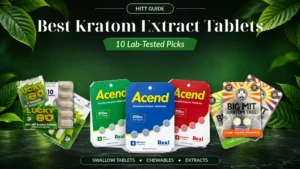
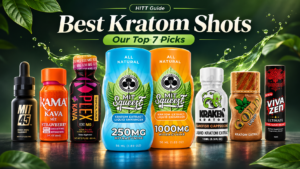
No. HITT sells mitragynine-based kratom and MIT + 13-OH products, and does not sell concentrated or boosted 7-OH products. Across its kratom powders, capsules, shots, and tablets, HITT lists the strength in milligrams and makes a COA available so you can confirm the alkaloids in each batch. If you are shopping the 13-OH category, compare the MIT and 13-OH amounts on the label and the COA before you buy.
13-OH vs 7-OH FAQs
Is 13-OH the same as 7-OH?
No. 13-OH is 13-hydroxymitragynine and 7-OH is 7-hydroxymitragynine. The number is the position on the mitragynine molecule, so they are different compounds.
What is 7-OH?
7-OH is short for 7-hydroxymitragynine, a minor alkaloid found naturally in kratom leaf and formed in the body as a metabolite of mitragynine. Most products sold as 7-OH are concentrated above the trace level in raw leaf.
What is 13-OH?
13-OH is short for 13-hydroxymitragynine, a newer kratom-associated label term. Products are usually labeled MIT + 13-OH, and the COA is the way to confirm the contents.
Is 7-OH being banned?
In 2025 the FDA recommended that concentrated 7-OH products be scheduled, and the DEA has moved toward scheduling 7-OH and related synthetics. Several states acted as well. Natural kratom leaf was not part of that recommendation, and the status continues to change, so check your local law.
How can I tell if a product contains 7-OH or 13-OH?
Read the compound name on the label, either 7-hydroxymitragynine or 13-hydroxymitragynine, check the milligrams listed, and confirm it on the product COA. The marketing name alone is not enough.
Does HITT sell 7-OH?
No. HITT carries mitragynine-based kratom and MIT + 13-OH products, and does not sell concentrated or boosted 7-OH products. A COA is available for its kratom.
Get new botanical guides and deals first
Join the HITT list. No spam, unsubscribe anytime.