
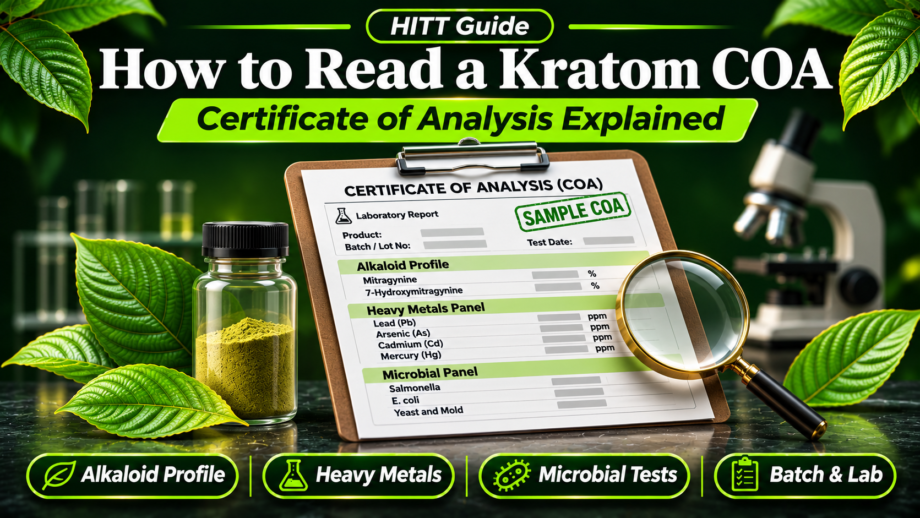
A certificate of analysis, or COA, is the lab report that tells you what is actually in a batch of kratom: the alkaloid content, and whether it passed testing for heavy metals and microbial contaminants. Learning to read one is the single most useful skill for buying kratom, because the color on the label and the brand name tell you how a product is marketed, while the COA tells you what a batch contains. This guide walks through what a kratom COA is, every section and column you will find on one, and the abbreviations labs use, using a real report as the example: a PharmLabs certificate of analysis for the PUFFR Blue Razz 300mg MIT kratom edible, broken down line by line. Every product in our kratom catalog cites a COA on its listing, and none of them is concentrated or boosted 7-OH.
TL;DR: A kratom COA is a third party lab report. It has a header (sample ID, product form or matrix, brand, dates, lab method), an alkaloid panel that reports mitragynine, 7-hydroxymitragynine, and minor alkaloids with their amounts, and often a safety panel for heavy metals and microbials. Learn four abbreviations first: ND means not detected, LOD is the limit of detection, LOQ is the limit of quantification, and mg per gram is how potency is reported. Check that the alkaloids are listed, that heavy metals sit below their limits, that pathogens read not detected, and that the paperwork names an accredited lab and a recent date. A COA describes the contents of a batch, not how a product will affect you.
What Is a Certificate of Analysis (COA)?
A certificate of analysis is a document from a testing laboratory that lists what a specific batch of a product contains and whether it passed each test. For kratom, the COA is produced when a sample from a production lot is sent to a third party lab, which measures the alkaloid content and, on a full report, screens for contaminants. The word batch matters here: a COA applies to one lot of product, identified by a sample or batch number, not to the brand as a whole. A trustworthy COA comes from an independent lab rather than the seller, carries a test date, and names the product it describes. It is the same kind of report used across supplements and botanicals, so if you have read a COA for one product you can read one for any kratom strain or color.
Why Kratom COAs Matter
Kratom is a plant product, so two things vary from batch to batch: how much of each alkaloid the leaf contains, and whether the lot picked up contaminants during growing, drying, or packing. The COA is how you check both. Lab tested kratom means a batch has been screened by a third party lab and has a report to show for it, rather than a label that simply says tested. Heavy metals can accumulate in any plant grown in soil, and microbial contamination can occur during handling, which is why the safety panels exist. The alkaloid panel, meanwhile, is how you confirm the potency on the label is real. Reading the report is how you separate a product that posts current lab results from one that only claims to be tested.
The Parts of a Kratom COA
A kratom COA has a header that identifies the sample, one or more result panels, and a footer with the lab credentials and an abbreviation legend. Many reports cover only the alkaloid panel, called a potency report, while others add the heavy metals and microbial panels, called a safety or full-panel report, so the first thing to check is which one you are holding. The PharmLabs report for the PUFFR Blue Razz 300mg MIT edible is a potency report. The table below shows each header line, what it tells you, and the value on that example report.
| Header line | What it tells you | PUFFR example |
|---|---|---|
| Sample | The product and batch the report covers | Blue Razz 300mg MIT |
| Sample ID | The lab’s unique code for the exact sample tested; it pairs with a QR code or lab portal so you can verify the report is real | SD260910-010 |
| Tested for | The brand or company that submitted the sample | Puffr |
| Matrix | The form the sample is in, such as powder, capsule, edible, or liquid; it changes how the lab prepares and tests it | Edible |
| Received / Reported | The date the lab got the sample and the date it issued the report; a recent date matters | Sep 10 2026 / Sep 11 2026 |
| Unit Mass | The weight of the single unit that was tested | 4.3 g |
| Num. of Servings / Serving Size | How many servings the unit holds and the size of one, used to calculate the per serving numbers | 20 servings / 0.22 g |
| Instrument / Method | The equipment and the standard procedure used, here HPLC for the alkaloids and a lab SOP code | HPLC VWD / SOP-KTM |
| Expanded Uncertainty | The margin of error on the measured results, given at a confidence level | approx 7.81% at 95% confidence |
The Alkaloid (Potency) Panel
The alkaloid panel is the heart of a kratom COA, and it reports more than one compound. Kratom leaf contains a family of alkaloids, and a panel lists several, each on its own line with its own result. The PUFFR report measures five of them. Mitragynine is the one present in the largest amount and the number most people look for. 7-hydroxymitragynine is a minor alkaloid that, on plain leaf and standard products, very often reads ND, meaning not detected. Several other minor alkaloids round out the profile. The table below explains each alkaloid on the panel, with the abbreviations the lab uses.
| Alkaloid | Abbreviation | What it is |
|---|---|---|
| Mitragynine | MITG | The primary and most abundant kratom alkaloid; the main potency number on the report |
| 7-hydroxymitragynine | 7HMG or 7-OH | A minor alkaloid; on plain leaf and standard products it frequently reads ND (not detected) |
| Speciogynine | SPEG | A minor leaf alkaloid listed on the panel |
| Speciociliatine | SPCL | Another minor leaf alkaloid; the one minor alkaloid detected on the PUFFR report |
| MGM-15 | MGM | A marker the lab reports; reads ND on this report |
Each alkaloid line carries several columns: a limit of detection and a limit of quantification in parts per million, then the result expressed four ways, as a percent and as milligrams per gram, per serving, and per unit. Here is the exact alkaloid panel from the PUFFR Blue Razz 300mg MIT report, in the order the lab lists it.
| Analyte | LOD ppm | LOQ ppm | Result % | mg/g | mg/Serving | mg/Unit |
|---|---|---|---|---|---|---|
| 7-hydroxy Mitragynine (7HMG) | 0.008 | 0.025 | ND | ND | ND | ND |
| MGM-15 (MGM) | 0.186 | 0.562 | ND | ND | ND | ND |
| Mitragynine (MITG) | 0.018 | 0.054 | 35.85 | 358.48 | 78.87 | 1541.46 |
| Speciogynine (SPEG) | 0.007 | 0.02 | ND | ND | ND | ND |
| Speciociliatine (SPCL) | 0.004 | 0.011 | 1.63 | 16.34 | 3.59 | 70.26 |
Three things stand out on this report. First, the 7-hydroxymitragynine line reads ND, not detected, which matters for a product sold on its mitragynine content and is not the same as a concentrated or boosted 7-OH product. Second, mitragynine reads 35.85 percent, or 358.48 mg per gram, which marks this as an extract edible rather than plain leaf: a plain leaf powder would read closer to 1 to 2 percent, about 10 to 20 mg per gram, and that jump is covered in our guide on kratom extract vs powder. Third, only one minor alkaloid, speciociliatine, was detected at 1.63 percent, while the rest read ND, which is a normal profile. HITT does not sell concentrated or boosted 7-OH.
How Kratom Potency Is Reported: Percent, mg/g, and mg per Serving
The alkaloid result is given four ways, and each answers a different question, which the PUFFR mitragynine line shows clearly. The percent column is the alkaloid as a share of the sample by weight, here 35.85 percent. The mg per gram column is that same figure as a weight, where 35.85 percent equals 358.48 mg per gram. The mg per serving column multiplies that by the serving size, so the 0.22 gram serving carries 78.87 mg of mitragynine, which is the number that tells you how much is in one piece. The mg per unit column scales it to the whole package, here 1541.46 mg across the full 4.3 gram unit and its 20 servings. When you compare two products, compare the same column, and lean on mg per serving for a real sense of what a single serving contains.
Kratom COA Terms and Abbreviations
Labs compress a lot of the report into short codes, and most of them appear in a legend on the COA itself. Learning this handful makes any kratom report readable. The ones below cover what you will see across the alkaloid, heavy metals, and microbial sections, plus the units labs use.
| Term | What it means |
|---|---|
| COA | Certificate of Analysis, the lab report itself |
| Analyte | Any single substance the lab measures; each alkaloid, metal, or microbe is one analyte |
| Matrix | The product form the sample is in, such as powder, capsule, edible, or liquid |
| ND | Not Detected; the analyte was not found above the detection limit |
| LOD | Limit of Detection, the smallest amount the method can detect at all |
| LOQ | Limit of Quantification, the smallest amount it can measure as a reliable number |
| <LOQ | Detected, but below the amount that can be reported as a precise number |
| >ULOL | Above the upper limit of linearity; too concentrated to measure precisely without dilution |
| UI | Unidentified; a signal the method could not assign to a known analyte |
| N/A | Not Applicable; NT means Not Reported |
| % | Percent of the sample by weight |
| mg/g | Milligrams per gram |
| mg/Serving | Milligrams in one serving, based on the serving size on the label |
| mg/Unit | Milligrams in the whole unit or package |
| ppm | Parts per million, used for heavy metals |
| CFU/g | Colony-forming units per gram, how microbial counts are reported |
| EU/mg | Endotoxin units per milligram |
| ug/kg, ug/mg | Micrograms per kilogram and micrograms per milligram |
| TNTC | Too Numerous To Count, a failing microbial result |
| HPLC | High-Performance Liquid Chromatography, the common instrument for measuring alkaloids |
| Method / SOP | The standard operating procedure the lab followed for the test |
The difference between LOD and LOQ is worth a closer look, because it explains the ND reading. The limit of detection is the point below which the method cannot reliably say anything is there at all, and the limit of quantification is the higher point above which it can report a trustworthy number. A result of ND means the analyte was below the detection limit, which is not the same as proving it is at absolute zero, only that it is below what the test can see. A result marked below the quantification limit means a trace was detected but was too small to report as a firm figure.
The Heavy Metals Panel
The PUFFR report is a potency-only COA, so it does not carry the next two panels; on a full or safety COA, the heavy metals panel lists lead, arsenic, cadmium, and mercury, each with a measured result and a limit, usually in parts per million. A result below the listed limit passes. These four metals are screened because they can accumulate in plants grown in soil, so the panel is a safety check on the growing and sourcing rather than a measure of quality in the leaf itself. When you read this section, look at two things: that all four metals are listed, and that each result sits below its limit. A report that omits heavy metals, or that shows a result above the limit, is a reason to choose a different batch.
The Microbial Panel
The microbial panel screens for bacteria and mold, and the pathogen lines should read not detected or absent. Common entries include a total aerobic count, yeast and mold measured in colony-forming units per gram against a maximum, and specific pathogen screens for Salmonella and E. coli. The pathogen screens are the strictest part of the report, because those organisms should not be present at any level in a product you consume. Counts like yeast and mold are compared to a maximum limit rather than needing to be zero, and a reading of TNTC, too numerous to count, is a failing result. If a COA skips the microbial panel entirely, you are missing half of the safety picture.
Accreditations, Signatures, and QR Codes
The footer of a COA is where you confirm the lab itself is legitimate, and the PUFFR report fills in every part of it. The strongest sign is ISO/IEC 17025, the international standard for testing-lab competence, usually shown with an accreditation number from a body such as PJLA, which stands for Perry Johnson Laboratory Accreditation; the PharmLabs report carries both, with accreditation number 85368. A kratom testing lab may also list a DEA license, because the alkaloid reference standards it uses are controlled, and this report shows one. Look as well for a version number, here V2, an authorized signature from the lab quality manager, and a QR code that lets you pull the same report from the lab directly, which defeats a doctored PDF. A report that carries an accreditation number, a signature, and a working verification link is one you can trust, while one that shows only a logo and no accreditation is weaker.
What a Trustworthy COA Includes
A COA you can rely on is specific, independent, and current. Specific means it carries a sample or batch number and names the exact product, so you can match it to the item in your hand. Independent means it comes from a third party lab rather than the seller, and the strongest reports name a lab with ISO/IEC 17025 accreditation. Current means it carries a test date that is reasonably recent, since a COA applies to the batch that was tested. The best listings make the report easy to find and let you read the actual document rather than a summary graphic. When all three of those hold, the report does its job.
Red Flags on a Kratom COA
A few patterns should make you pause. There is no sample or batch number, so the report cannot be tied to a specific product. There is no test date, or the date is years old. The heavy metals or microbial panels are missing on a product sold as fully tested. The document is a graphic or a claim rather than a readable lab report. The product name or matrix on the report does not match what you are buying. No accreditation number or verification link appears anywhere. Any single one of these is a reason to ask the seller for a complete, current COA, or to choose a batch that posts one. A label that says lab tested without a document to back it is a claim, not a COA.
Where to Find the COA on Our Listings
Every product in our catalog cites its lab report on the product page, so you can read the COA before you buy. Whether you are looking at a plain leaf kratom powder, a capsule, or an extract, the listing points you to the report for that product. Use this guide as a checklist when you open one: confirm the sample details and matrix, scan the alkaloid panel and note the mg per serving, check that any heavy metals and microbial panels passed, and make sure the lab is accredited and the date is current. Reading the COA is the step that turns a label you are trusting into a batch you have actually checked.
Kratom COA FAQs
What is a kratom COA?
A kratom COA, or certificate of analysis, is a third party lab report for a specific batch of kratom. It lists the alkaloid amounts, such as mitragynine and 7-hydroxymitragynine, and on a full report the heavy metals and microbial results, each next to its limit. It describes what a batch contains, identified by a sample or batch number.
What does ND mean on a kratom COA?
ND means Not Detected: the analyte was below the method’s limit of detection, so the test could not find it. It is common to see ND on the 7-hydroxymitragynine line of a plain leaf report. ND means below what the test can see, which is not the same as proving an absolute zero.
What are LOD and LOQ on a COA?
LOD is the limit of detection, the smallest amount the method can detect at all. LOQ is the limit of quantification, the smallest amount it can measure as a reliable number. A result between the two may be marked as below the quantification limit, meaning a trace was found but was too small to report as a firm figure.
What alkaloids are listed on a kratom COA?
It varies by lab, but a kratom panel reports mitragynine as the main compound, 7-hydroxymitragynine as a minor one that often reads ND, and several other minor alkaloids. The example PUFFR report lists five: mitragynine, 7-hydroxymitragynine, speciogynine, speciociliatine, and MGM-15. Each is shown with its detection limits and its result in percent and milligrams.
What does mg/g mean, and how is it different from mg per serving?
The mg per gram figure is how much of an alkaloid is in each gram of the product, and it equals the percent times ten, so 1.5 percent is 15 mg per gram. The mg per serving figure multiplies that by the serving size on the label, so it tells you how much is in one capsule, gummy, or scoop. Compare the same column across products.
Is a high mitragynine percentage bad?
No, it just signals concentration. Plain leaf powder reads around 1 to 2 percent mitragynine, while a concentrated extract or an extract edible can read 30 percent or more. The figure tells you how concentrated the product is, not how it will affect you. The COA for the specific product is the reliable number.
What makes a lab and its COA trustworthy?
Look for ISO/IEC 17025 accreditation with an accreditation number from a body such as PJLA, an authorized signature, and a QR code or portal link that pulls the same report from the lab. A report that is specific to a batch, independent of the seller, and recently dated is one you can rely on.
Does lab tested kratom need a COA?
Yes. Lab tested should mean a third party lab has screened a batch and produced a report you can read, which is the COA. A label that says lab tested without a document to back it is a claim rather than proof, so look for the actual report, with an accreditation number and a date, on the product page.
Browse lab tested kratom with a certificate of analysis cited on every listing, plus free shipping over $75.
Get new botanical guides and deals first
Join the HITT list. No spam, unsubscribe anytime.